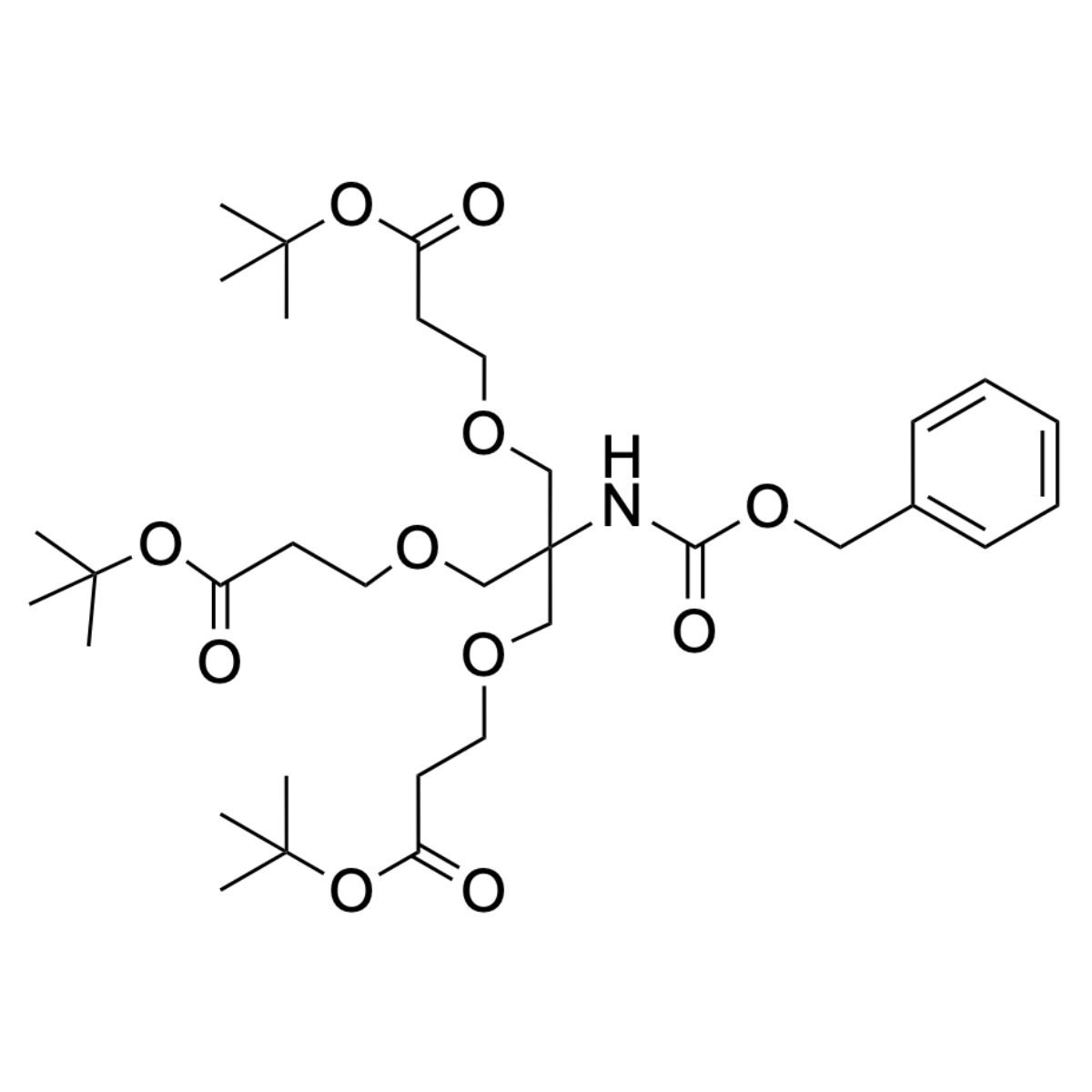
Di-tert-butyl 3,3-((2-(((benzyloxy)carbonyl)amino)-2-((3-(tert-butoxy)-3-oxopropoxy)methyl)propane-1,3-diyl)bis(oxy))dipropionate
IUPAC Name: di-tert-butyl 3,3-((2-(((benzyloxy)carbonyl)amino)-2-((3-(tert-butoxy)-3-oxopropoxy)methyl)propane-1,3-diyl)bis(oxy))dipropionate
Synonyms:
CAS No: 200133-20-6
Catalog No:
Brand: Daisa Biopharma
Category: Small Molecule
Tag: PEG, PEG Linkers,
Molecular Formula: C33H53NO11
Molecular Weight: 639.77
Pack Size Available: 25 g, 100 g, 500 g
Place of Origin: India
Product Description
PEG linkers, also known as PEG reagents, are chemically functionalized polyethylene glycol (PEG) compounds widely used in bioconjugation, drug development, molecular labeling, and biomedical research. These specialized PEG linkers contain reactive functional groups that enable the efficient conjugation of proteins, peptides, antibodies, drugs, and other biomolecules.
PEG linkers are particularly valuable as cross-linkers and bioconjugation reagents due to their excellent water solubility, low toxicity, low immunogenicity, and favorable biocompatibility. By incorporating PEG spacer arms between molecular components, PEG reagents can improve solubility, flexibility, stability, and accessibility in conjugated biomolecules.
Our range of PEG linkers and PEG reagents is suitable for applications including protein modification, antibody-drug conjugates (ADCs), targeted drug delivery, fluorescent labeling, diagnostics, proteomics, and life-science research. Explore PEG linkers with different spacer lengths and reactive groups for your specific bioconjugation and chemical synthesis requirements.
Appearance: Liquid
HPLC purity: ≥98% a/a
Recommended Products & New Products
About Us
We are a multidisciplinary research organization specializing in Medicinal Chemistry, Process Chemistry, and Biocatalysis—delivering scalable, efficient, and sustainable solutions for complex scientific challenges.
Our medicinal chemistry division drives early-stage drug discovery through the design and synthesis of novel chemical entities, SAR exploration, and creation of natural-product-inspired molecular libraries.
We develop safe, robust, and scalable synthetic routes for APIs and intermediates. Our expertise covers QbD-driven development, impurity profiling, polymorph optimization, and complete CMC/DMF support.
Our biocatalysis services include enzyme screening, whole-cell bioconversion, and industrial bioprocess scale-up—enabling greener, more cost-effective, and sustainable alternatives to traditional chemical transformations.